Electric Bass: Active or Passive?
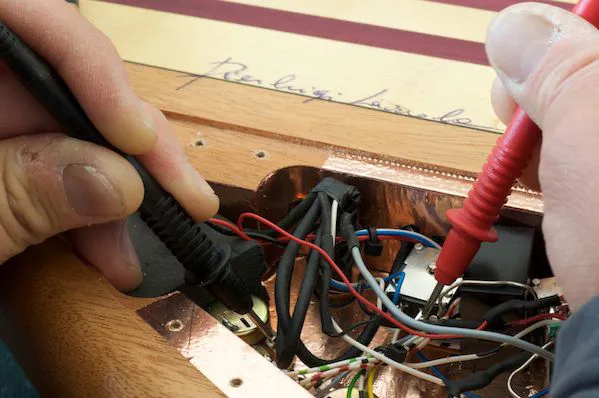
Laurus basses are available in both "Active" and "Passive" versions.
The electric bass was originally “Passive” since 1935 and remained so until the mid-1970s.
In a “passive” electric bass, the “dynamics” and the tone of the pickups are fully preserved. It can be equipped with one or two pickups (Humbucker or Single Coil). The tone controls of a passive bass typically include one or two Volume knobs and one or two treble-cut controls, using a capacitor to slightly “soften” the sound.
“Active” tone controls offer the convenience of shaping and equalizing the sound “directly from the instrument,” avoiding the need to adjust the amplifier, which may be in a hard-to-reach position on stage. Early active tone controls often compressed the dynamics of the pickups, limiting the musician’s expressive possibilities.
Today, in high-quality basses, dynamics are better preserved.
Laurus basses are available in both “Active” and “Passive” versions, switchable via the main Volume knob (Push-Pull).
The “Active” option on Laurus basses has been specifically designed not to interfere with the pickups’ dynamics at all, allowing the musician maximum expressive control over the instrument.
In the “Passive” mode of Laurus basses, the active tone controls (Bass-Mid-Treble) are disabled, but the treble control works in “passive” mode, together with the main Volume and the pickup balance.
Active or passive electric bass is the main subject of this article, but what else is in a Laurus bass?
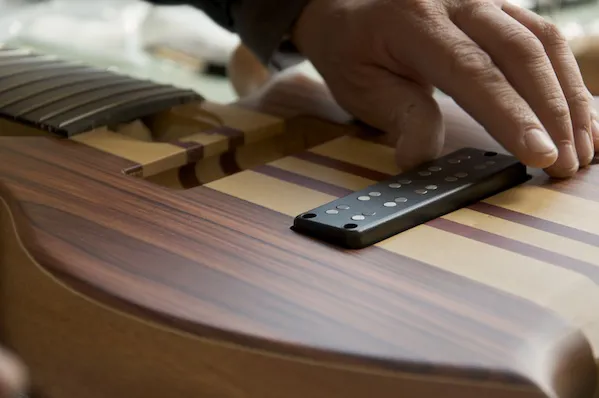
To enhance their basses’ performance, in addition to the Active–Passive option, Laurus instruments feature highly engineered luthiery to maximize the vibration of the woods used. Consequently, Laurus chooses pickups with a very wide dynamic range, particularly sensitive and capable of “reading” the luthiery itself.
Laurus prefers “non-paraffin-coated” pickups with free winding. The key characteristic is their ability to read the luthiery with great sensitivity, which, if properly balanced, allows the instrument to adapt extremely well to any musical style.
Visit Nordstrand’s website for more information.
Why is Laurus one of the best brands on the market?
Laurus is one of the top brands because it combines the principles of classical luthiery with the latest mechanical and electronic technologies.
Pierluigi Cazzola (Founder and Creator: Laurus started in 1982) studied “Tone Chambers” in depth and, in 2009, designed the “Suspended Harmonic Tops.”
“It involved carving the harmonic top of the body above the Tone Chamber,” Pierluigi explains, “transforming it into a vibrating body, making the chamber resonate much more and significantly increasing the body’s sensitivity.”
Laurus bass bodies come standard with two Tone Chambers: one on the upper wing of the body with the Suspended Harmonic Top, and one in the center of the body, tuned via small tubes inserted into the chamber to adjust its intonation. In the Extraharmonic model, the Suspended Harmonic Tops can be up to three, remarkably increasing sustain due to the high sensitivity of the body.
What makes a Laurus electric bass a professional instrument?
Its precise construction, the reliability of the mechanical components (even more performant in newer models), the high quality of the electronics, and the inclusion of premium accessories make it a highly appreciated instrument for both professional musicians and high-level amateurs.